We carefully reviewed our product range to identify the most commonly used materials. Wood stands out, making up 51% of our assortment. Animal feed – such as birdseed, fat balls, and peanuts – follows at 21%. Metal accounts for about 9%, with the remaining materials making up a smaller share.
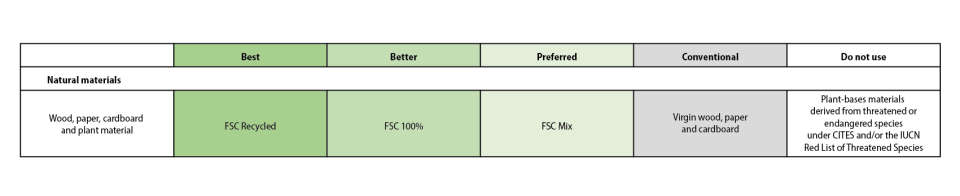
To make more conscious material choices, we use an internal materials guide. This helps us determine the most and least desirable options per material type. For example, for wood, paper, and cardboard, it looks like this:
In product development, we consider this materials guide, alongside material availability and our suppliers’ capabilities. For example, there are often more sustainable options available for wood and plastics than for metal.
Wood, Paper and Cardboard – FSC®
Since 2006, we have been FSC® certified. The FSC® label guarantees that wood or paper comes from responsibly managed forests or recycled sources. Forest management considers biodiversity, ecosystems, local communities, and ensures safe working conditions. FSC®-certified wood comes from forests managed according to international standards for responsible forestry. This means, among other things, that logging takes into account the long-term preservation of the forest and workers’ rights. Conventional wood does not offer these guarantees.
Currently, about 85% of all our wood is FSC® certified, and we are working towards 100% certification for all non-European wood we purchase.
Our FSC® products carry one of the following labels:
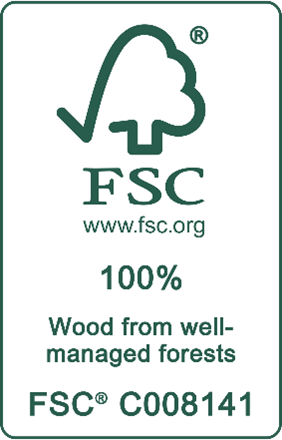
The entire product consists of sustainably certified wood. This is the most common label on our products.
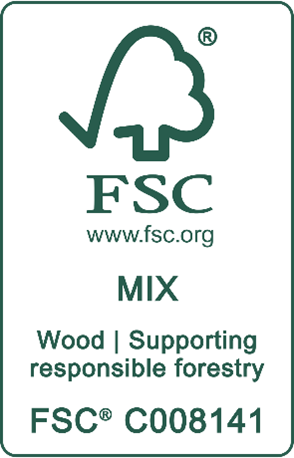
Made of at least 70% FSC® certified wood and up to 30% controlled wood from other sources. Often used for paper products.
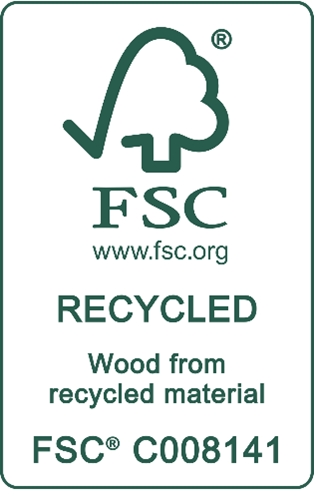
Made entirely from recycled material, with at least 85% post-consumer (e.g., old packaging or furniture) and up to 15% pre-consumer material (e.g., production waste). You’ll find this label on packaging and our biodegradable gardening products.
Recycled Material – GRS & RCS
Since 2025, we are certified under the Global Recycled Standard (GRS) and the Recycled Claim Standard (RCS).
These certifications prove that a product contains at least 50% recycled material.
Using recycled materials reduces demand for virgin resources, saves energy, lowers CO₂ emissions, and reduces waste.
This supports more sustainable production and helps reduce environmental impact.
Achieving 100% recycled content is sometimes not feasible due to technical limits, raw material availability, or desired finishes, but we aim for the highest possible percentage.
Labels always indicate:
- The percentage of recycled material
- Whether the material is pre-consumer (production waste) or post-consumer (previously used)
Examples: fabric remnants from garden glove production (pre-consumer) or old plastic bottles (post-consumer).
Firewood – Ready to Burn
For our firewood, we use the Ready to Burn certification. This label guarantees a moisture content of 20% or less, ensuring more efficient burning with less smoke, fine dust, and heat loss. This is important because wood that is too wet burns poorly, produces less heat, generates more smoke and soot, and can cause creosote buildup in chimneys, increasing fire risk.
Our certified firewood blocks and kindling wood carry this label.
Wood Pellets – ENplus
Since 2025, all our wood pellets are ENplus certified. This internationally recognized label guarantees the quality, sustainability, and traceability of pellets from production to delivery.
ENplus-certified pellets:
- Have a consistent calorific value
- Contain low moisture and ash content
- Are stored and transported cleanly
- Reduces smoke and wer on pellet stoves
ENplus has three quality classes: A1, A2, and B.
A1 is the highest quality, with low ash and moisture, intended for household use.
A2 has slightly higher ash content and is suitable for larger installations or light industrial use.
B is the lowest class, with the highest ash and contaminant levels, intended for industrial applications.
We only use ENplus A1, the highest quality for private use. Certified pellets carry the ENplus logo.
Why Choose Certified Products?
In a market flooded with information, including on sustainability, it can be difficult to know what is trustworthy. Third-party certifications, like the ones above, guarantee that a product truly contains the sustainable element claimed. Moreover, the EU’s anti-greenwashing rules and market regulators strictly limit how sustainability claims may be communicated. Certified products therefore provide certainty. You can use them to meet your ESG goals on sustainable materials, as a USP to stand out in the market, and to respond to growing consumer demand for responsible choices. Additionally, certified products reduce the environmental impact compared to conventional alternatives.